

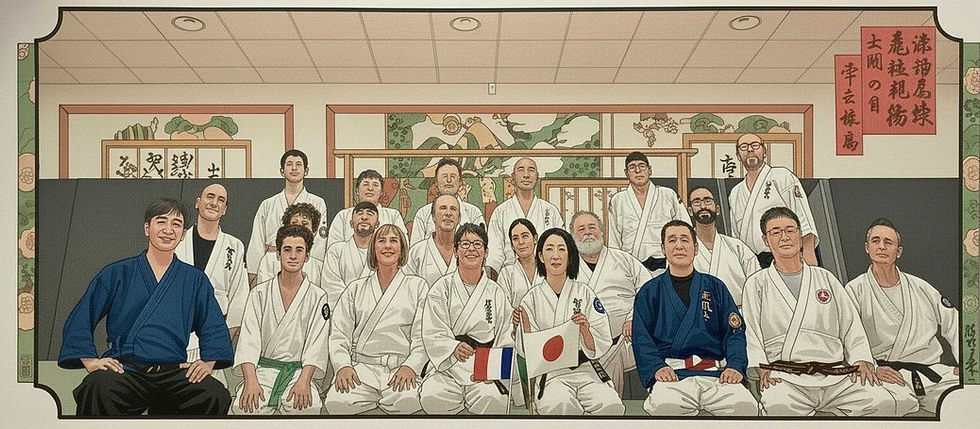
BUDOSPRING 2026: Day 3 Report

On the final day of the seminar, for the benefit of those participating for the first time, I began by revisiting the definition of Budo and explaining the fundamental differences between Budo (the martial way) and Bujutsu (martial techniques).
日本語はこちら
The central theme of this session was a deep dive into the meaning of Rei (etiquette/bowing). While the phrase "Budo begins and ends with Rei" is a cornerstone of the practice, my experience visiting numerous dojos has shown that even those with excellent technique often treat their etiquette as a second thought. Drawing from my personal experience in other Japanese traditional arts—such as Sado (tea ceremony), Kado (flower arrangement), and Shodo (calligraphy)—I explained the profound significance of the bow. Through the practice of Zarei (seated bow) and Ritsurei (standing bow), we discussed how one’s manner of bowing serves as a true reflection of their character.
In the practical portion of the lecture, the focus shifted to footwork and how effective movement translates into efficient Tai-sabaki (body management). I introduced a specific method of movement distinct from standard Suri-ashi (sliding steps). By rotating on the heel and shifting the center of gravity to the toes during the transition, the practitioner can significantly broaden the angle and range of the upper body’s movement.
It was a profound session that connected spiritual discipline with physical logic, providing a fitting conclusion to the three-day program.


Comments